Jiu-Jitsu gives you a practical way to burn off stress, reset your focus, and leave class feeling lighter.
Stress shows up in the body first: tight shoulders, short temper, restless sleep, that wired feeling at the end of a long day. In Spokane Valley, we see it across every schedule and age group, from demanding jobs to family responsibilities to the kind of winter gloom that can make motivation feel slippery. The good news is you do not have to white-knuckle your way through it.
Jiu-Jitsu is one of the most reliable stress relief tools we teach because it pulls you into the present moment. You cannot mentally replay emails while you are learning to frame, shrimp, and breathe under pressure. You have to be where your hands are, where your hips are, where your balance is. That focus is not just a training skill, it is a wellness skill.
We built our adult training environment around exactly that idea: hard days happen, and you deserve a place where you can train safely, think clearly, and feel part of a community that understands what stress looks like in real life.
Why Jiu-Jitsu works so well for stress relief
Stress relief is not only about relaxing. It is also about giving your nervous system a structured challenge, then teaching it to recover. Jiu-Jitsu does that in a way most workouts cannot. You face pressure, problem-solve, breathe, and adapt, all while staying controlled.
Research on Brazilian Jiu-Jitsu continues to point in a promising direction for mental health. Studies have shown meaningful improvements in markers tied to anxiety, depression, PTSD symptoms, and overall psychological well-being for people who train consistently. Long-term practitioners also tend to report higher resilience, grit, self-control, and life satisfaction compared to newer students, which matches what we see on the mats: the longer you train, the more capable you feel under pressure, on and off the mat.
In practical terms, Jiu-Jitsu becomes a repeatable weekly reset. You arrive carrying the day, you train with intention, and you leave with your body tired in a good way and your mind quieter.
The moving meditation effect: focus replaces rumination
A lot of stress comes from looping thoughts. Jiu-Jitsu interrupts that loop because the feedback is immediate. If your posture is off, you feel it. If your breathing gets choppy, you notice it fast. When you are drilling a technique, your attention lands on details like grips, angles, and timing, not worries.
This is why many students describe class as a kind of moving meditation. It is not passive, but it is grounding. The structure helps: warmup, technique, drilling, positional work, then controlled sparring. Each phase narrows your attention and gives you a clear task, which is surprisingly calming.
Over time, that skill transfers. You start catching stress earlier in your day. You breathe more deliberately. You recognize when you are tense and you have a practiced way to shift gears.
Stress hormones, breath control, and the body’s reset button
One of the simplest things we teach, even without calling it wellness, is breath control under pressure. In grappling, holding your breath is a common beginner mistake. It spikes fatigue and panic. Learning to breathe steadily changes everything.
When you practice staying calm in uncomfortable positions, your body learns a new default response. Instead of instantly bracing and tightening up, you learn to create space, frame, and escape step by step. That is not just a technique lesson, it is nervous system training.
If you work in a high-stress profession, this matters. If you are a parent managing a household, it matters. If you just want your evenings back, it matters. Two classes per week is a strong starting point, and recent survey-style research has reported that trainees practicing about twice weekly commonly notice improvements in resilience and focus.
Why adult Jiu-Jitsu in Spokane Valley fits real schedules and real stress
Adults do not need another obligation that feels like a performance. You need something you can show up to as you are, train progressively, and improve without pressure to be perfect. That is how we run adult Jiu-Jitsu in Spokane Valley: scalable intensity, clear coaching, and a culture where you can ask questions without feeling like you are slowing things down.
Spokane Valley also has a strong community of veterans, first responders, and people in physically demanding roles. The stress load is different in those careers, and the need for resilience is constant. Jiu-Jitsu gives a controlled place to practice pressure management, decision-making, and composure, with partners who understand the value of training smart.
And if you are simply worn out from modern life, you are in the right place too. We see students start training for stress relief, then stay because life feels better when you have a challenging hobby that is also good for your health.
What changes first: the early wins you can expect
Most people notice mental changes before physical ones. The first few weeks usually bring better sleep, a more stable mood after class, and a sense of accomplishment that is hard to get from a treadmill. You also start building trust in your body again, which is a quiet kind of confidence.
Physically, the benefits stack quickly: improved cardiovascular fitness, stronger hips and core, better mobility, and the kind of usable endurance that helps in daily life. Jiu-Jitsu also tends to encourage smarter movement habits, because efficiency matters. When technique improves, you waste less energy, and that shows up outside the gym too.
If you like tracking progress, we recommend a simple training journal. Write down what you drilled, what felt stressful, what felt better than last week. Seeing that arc on paper is motivating, especially on days when work has been a lot.
How we keep training safe while still challenging
Stress relief only works if training feels safe. That does not mean easy, it means structured. We emphasize tapping early, controlled rounds, and a coaching approach that keeps beginners out of chaotic situations while still letting you learn.
Safety is also about pacing. If you are returning to fitness, dealing with an old injury, or just nervous about contact sports, we meet you where you are. Jiu-Jitsu can be low-impact compared to striking-heavy training because much of the work is positional, technical, and done close to the ground. We also include conditioning that supports injury prevention: stronger joints, better posture, and improved movement mechanics.
If you have specific concerns, we would rather you bring them up right away. Most issues can be addressed with smarter partner selection, positional goals, or modifying intensity while you build capacity.
The mind skills you build without realizing it
Jiu-Jitsu is often called “human chess,” but the real value is how it trains decision-making under stress. You learn to slow down, pick one problem, and solve it with technique instead of panic. That is a life skill.
You also build frustration tolerance. Some days you feel unstoppable, and some days you get stuck in side control a lot. Learning to keep a good attitude, keep showing up, and keep learning is where resilience actually comes from. Research comparing experienced practitioners to novices often shows higher scores in traits like grit, self-efficacy, and self-control among advanced students, and that pattern makes sense: you cannot train for years without learning how to persist.
This is one reason Jiu-Jitsu in Spokane Valley has become such a powerful wellness outlet. It is not only about fitness. It is about becoming harder to knock off center.
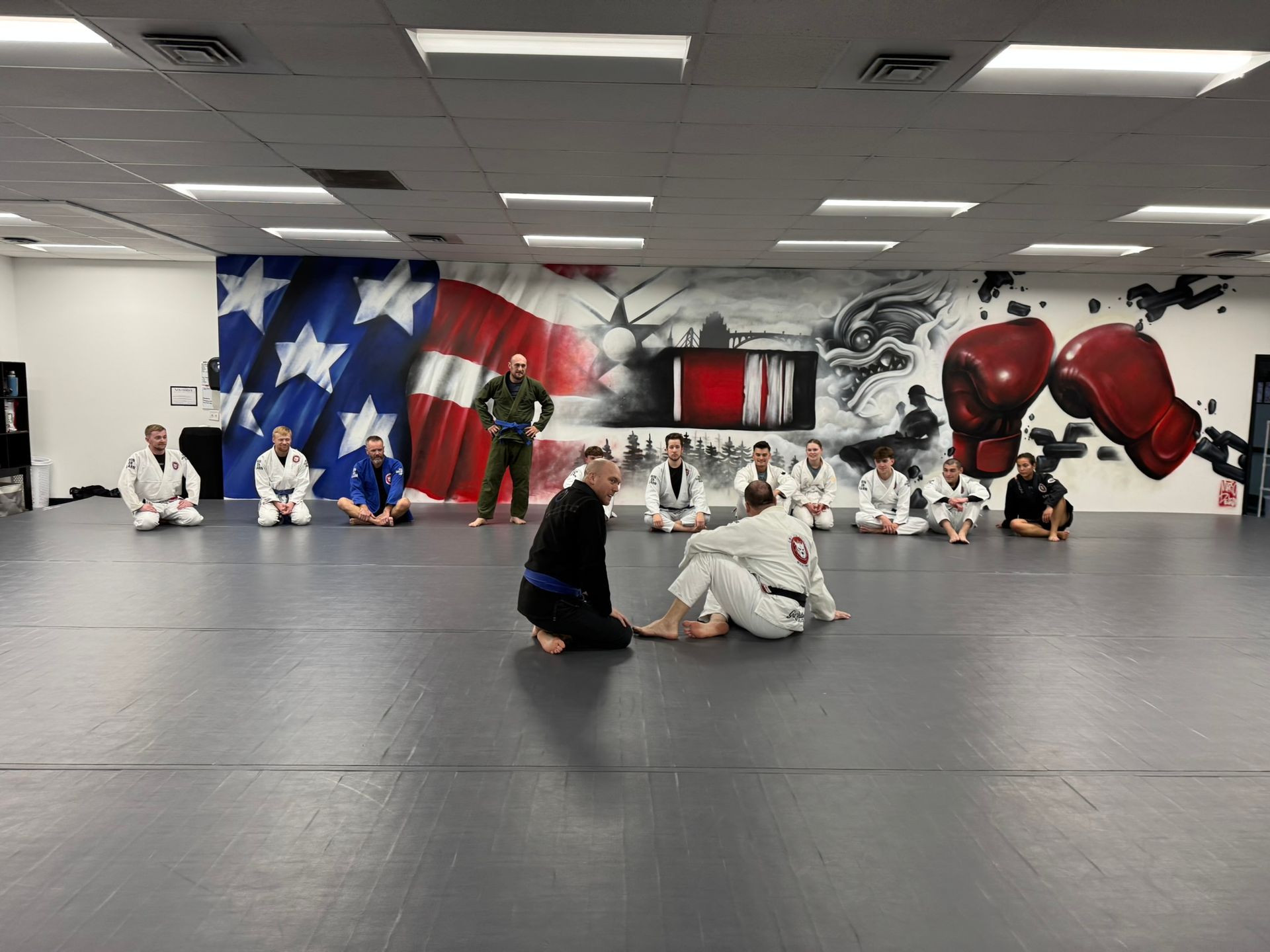
What a typical adult class feels like
Walking into your first class can feel like stepping into a new world, but we keep the experience straightforward. Expect a warm welcome, a clear plan, and coaching that assumes you are new until you tell us otherwise.
A typical session includes technique instruction, drilling, and live training that matches your experience level. You will get to move, think, and sweat, but you will not be thrown into the deep end without support. We also encourage you to take breaks, sip water, and pace yourself. Consistency matters more than going all-out on day one.
To make this concrete, here are a few stress relief benefits students commonly report after they settle into training:
• A quieter mind after class because your attention has been fully occupied by technical problem-solving
• Better sleep quality from physical exertion paired with nervous system downshift afterward
• Increased confidence in everyday situations because you practice staying calm under pressure
• A healthier relationship with discomfort, since you learn to breathe and work through tough positions
• A community routine that replaces isolating habits with shared effort and accountability
A simple plan to start training for stress relief
You do not need a dramatic lifestyle overhaul. You need a realistic plan that fits your week. We suggest starting small, then building.
1. Pick two training days per week and treat them like appointments with yourself
2. Focus on fundamentals for the first month, even if you feel tempted to rush ahead
3. After each class, write down one technique detail and one mindset win you noticed
4. Prioritize recovery basics: hydration, protein, and a consistent bedtime on training nights
5. Reassess after four weeks and decide if adding a third class supports your stress levels
This kind of structure keeps Jiu-Jitsu from becoming another chaotic commitment. It becomes a stabilizer.
Training as a social support system, not just a workout
One of the most underrated parts of Jiu-Jitsu is the room itself. Adults need community, and modern life does not make it easy to find. Training partners learn your name, notice when you improve, and encourage you through plateaus. That social reinforcement is a genuine stress buffer.
We also see strong outcomes when families train in the same space, even if not always in the same class. Research trends around martial arts participation suggest family involvement can strengthen bonds and reduce anxiety across ages. Practically, it also means your household starts speaking the same language: discipline, consistency, and respectful effort.
If you are looking for adult Jiu-Jitsu in Spokane Valley because you want a healthier routine, the community piece matters as much as the techniques.
Take the Next Step
Building a calmer, stronger baseline does not happen from reading about it, it happens from practicing it. Jiu-Jitsu gives you a repeatable way to discharge stress, sharpen focus, and rebuild confidence through small wins that add up week after week.
When you are ready to train in Spokane Valley, we would love to show you how our adult programs are designed for real life and real schedules at Grit Jiu-Jitsu & Muay Thai Martial Arts. You can start where you are, learn at a steady pace, and make stress relief part of your routine instead of an occasional hope.
Improve your fitness, confidence, and grappling ability by joining a Jiu-Jitsu class at Grit Jiu-Jitsu & Muay Thai Martial Arts.